
ERPC Edge offers multichain RPC for 16 chains, including Solana and Ethereum, with one RPC key
ERPC, operated by ELSOUL LABO B.V. (Headquarters: Amsterdam, the Netherlands; CEO: Fumitake Kawasaki), provides ERPC Edge, a multichain RPC service that connects developers to 16 chains, including Solana, Ethereum and Base, with one RPC key. As an application adds support for more chains, developers can use their existing RPC key to implement data retrieval and transaction submission.
For example, when adding Ethereum or Polygon data to an application that uses Solana, developers configure the target chain's endpoint and requests while continuing to use their existing ERPC RPC key. Developers can manage credentials and RPC usage together across chains by sharing the same RPC key and ERPC token allowance. Network routing also connects users automatically to a nearby edge in a network of more than 300 locations worldwide, so they do not need to select a connection region.
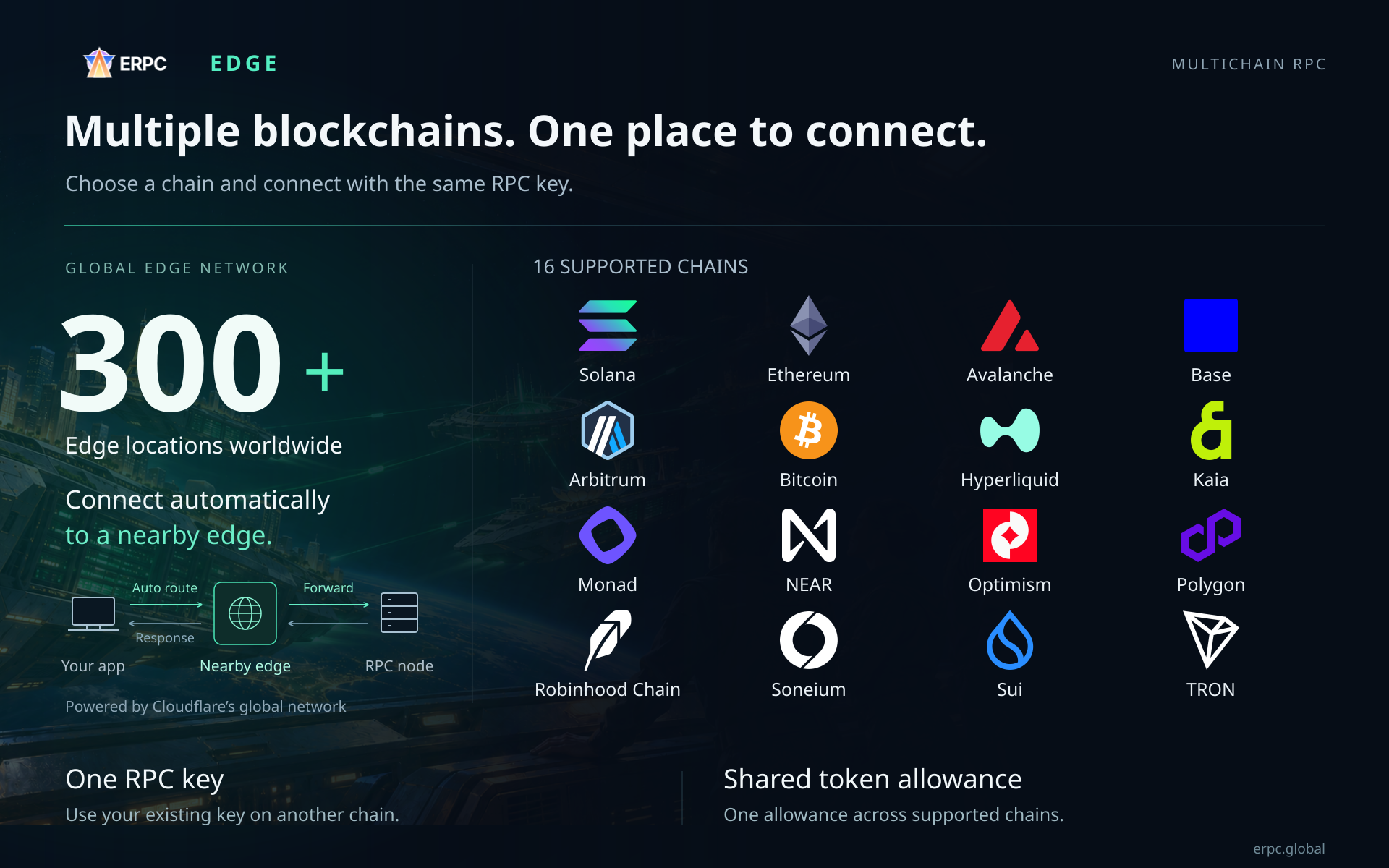
Support for 16 chains, including Solana and Ethereum
The 16 supported chains are Solana, Ethereum, Avalanche, Base, Arbitrum, Bitcoin, Hyperliquid, Kaia, Monad, NEAR, Optimism, Polygon, Robinhood Chain, Soneium, Sui and TRON. The dashboard's Edge page provides the endpoint and usage instructions for each chain.
Developers can choose chains to suit their applications while keeping RPC key management and the usage allowance within the same service as a project grows. Example uses include:
| What you are building | How ERPC Edge can be used |
|---|---|
| Multichain wallets and asset dashboards | Retrieve balances and transaction data from multiple chains and display them in one application |
| Analytics tools and application backends | Add Ethereum or Polygon data retrieval to an existing Solana integration and connect with the same RPC key |
| Support for a new chain or a proof of concept | Verify connections and methods on the target chain using a shared allowance, then validate the implementation |
Request methods and parameters follow the specifications of the target chain. Ethereum and Polygon use HTTP JSON-RPC, while Sui uses gRPC-web. Supported methods and WebSocket availability depend on the chain and plan. Each chain's quickstart provides connection instructions and implementation examples.
ERPC documentation:
https://erpc.global/en/doc/rpc/general/
RPC endpoints: a shared domain with chain-specific paths
All 16 supported chains are available through the shared hostname
edge.erpc.global. The URL path selects the chain, such as /eth for Ethereum, /base for Base and /polygon for Polygon.| Chain | Example endpoint |
|---|---|
| Solana | https://edge.erpc.global |
| Ethereum | https://edge.erpc.global/eth |
| Polygon | https://edge.erpc.global/polygon |
| Base | https://edge.erpc.global/base |
For the four chains in the table, pass your ERPC RPC key in the URL's
api-key parameter. Find the key under RPC Keys in the dashboard settings, which is separate from API Keys. For example, the following request retrieves the latest Ethereum block number. Replace YOUR_RPC_KEY with your ERPC RPC key.bash
curl 'https://edge.erpc.global/eth?api-key=YOUR_RPC_KEY' \
  --header 'Content-Type: application/json' \
  --data '{"jsonrpc":"2.0","id":1,"method":"eth_blockNumber","params":[]}'
curl 'https://edge.erpc.global/eth?api-key=YOUR_RPC_KEY' \
--header 'Content-Type: application/json' \
--data '{"jsonrpc":"2.0","id":1,"method":"eth_blockNumber","params":[]}'On success, the response's
result field contains the latest block number in hexadecimal. An ERPC RPC key already used for Solana can also be used for this request. To retrieve the latest Polygon block number, keep the same RPC key and eth_blockNumber method, and change the endpoint path from /eth to /polygon.Follow each chain's quickstart when configuring authentication. For example, the Sui SDK passes the key in an
Authorization: Bearer header.Ethereum RPC quickstart:
https://erpc.global/en/doc/ethereum-rpc/quickstart/
Polygon RPC quickstart:
https://erpc.global/en/doc/polygon-rpc/quickstart/
Share one RPC usage allowance across supported chains
ERPC tokens are units used within ERPC to measure RPC usage. With ERPC Edge, a plan's token allowance is shared across all supported chains.
For example, retrieving data from both Solana and Ethereum draws from the same token allowance. Developers do not need to manage a separate allowance for each additional chain. One allowance can be used across the chains required by a project or application. Each chain does not receive a separate allowance of the same size.
Token consumption and request limits follow the conditions for the chain, method and plan in use. When estimating usage, check the token consumption of the methods your application needs and the plan's rate limits.
Connect automatically to a nearby entry point across 300+ edge locations
ERPC Edge uses Cloudflare's global network, with more than 300 edge locations worldwide serving as connection entry points. When an application accesses an endpoint, it automatically connects to an edge that is nearby in terms of the network route.
Requests are forwarded through that edge to the corresponding RPC node, and responses are returned to the application. This reduces the need to select different regional endpoints while providing a consistent way to connect from different regions.
The infographic's “300+” refers to these global edge locations. The architecture combines the RPC nodes that retrieve blockchain data with the edges that serve as their entry points.
Use the RPC Free plan for development and PoCs
The RPC Free plan is available for ERPC Edge connection checks and PoCs at a monthly fee of €0. Standard activation requires a €5 payment verification step. This is part of the initial activation process and is separate from the Free plan's monthly fee.
The Free plan refills 4.2 million tokens at the start of each month in UTC, shared across supported chains. Unused tokens from the monthly free allowance do not carry over. Tokens measure RPC usage, so 4.2 million tokens does not mean 4.2 million requests.
Start by checking the behavior and token consumption of the methods your application needs, then choose a plan based on the required usage allowance and rate. Rate limits follow each chain's usage conditions. For example, Base and Polygon allow one request per 10 seconds per account on the Free plan. Requests to other chains can also count toward that limit, so follow each chain's quickstart when setting the interval between requests.
RPC pricing and plans:
https://erpc.global/en/price/
From the dashboard to your first RPC request
To get started:
- Log in to the ERPC Web Dashboard, complete any activation steps required by your plan, and find the key you want to use under RPC Keys in settings.
- Open the dashboard's Edge page and find the endpoint URL and quickstart for the chain you want to use.
- Configure the RPC key and endpoint in your application, then send requests supported by that chain.
To try Ethereum, use the
eth_blockNumber example above to check the first response, then implement the data retrieval or transaction submission your application needs.ERPC Web Dashboard:
https://dashboard.erpc.global/en/
Related links
- ERPC: https://erpc.global/en/
- RPC pricing and plans: https://erpc.global/en/price/
- Ethereum RPC: https://erpc.global/en/doc/ethereum-rpc/general/
- Base RPC: https://erpc.global/en/doc/base-rpc/general/
- Monthly token refills for RPC Free: https://erpc.global/en/news/2026/11/04/erpc-rpc-free-monthly-tokens-20261104/
- Multichain support for Unlimited Endpoints: https://erpc.global/en/news/2026/11/05/erpc-unlimited-endpoints-multichain-20261105/