
SLV Goes Native Multilingual — Solana Node Operations and AI Agent Development in Your Mother Tongue
SLV Goes Native Multilingual — Solana Node Operations and AI Agent Development in Your Mother Tongue
ELSOUL LABO B.V. (headquartered in Amsterdam, the Netherlands; CEO: Fumitake Kawasaki) and Validators DAO are pleased to announce that SLV, the open-source Solana development tool we develop and operate, has launched native multilingual support in its latest release, v2026.4.13.1648.
By selecting a language in the onboarding wizard, users can now run not only the wizard guidance but also the entire AI Console conversation with the AI agent in their mother tongue. The preset languages are English, Japanese, Chinese, Russian, and Vietnamese — five languages in total. In addition, selecting "Other" and entering any language name unlocks support for languages beyond the presets.
SLV Official Site: https://slv.dev/en
SLV GitHub: https://github.com/validatorsDAO/slv
Why Native Multilingual Support — A 100+ Country User Base and the Efficiency Gap of Working in Your Mother Tongue
The Validators DAO ecosystem, centered on ERPC and SLV, brings together users from more than 100 countries worldwide. Solana validator operators, Solana RPC operators, high-frequency traders, bot developers, infrastructure engineers, researchers — professionals of different nationalities and native languages use this ecosystem daily as a place to share real-world Solana infrastructure operational knowledge.
Until now, SLV has operated on an English-first basis. Technical documentation, the onboarding wizard, AI agent conversations — English was the default everywhere. However, the vast majority of our users are not native English speakers, and each of them is far more fluent in their own language. When using AI and software, whether you can read and write in your mother tongue makes an order-of-magnitude difference in working efficiency.
This gap shows up most clearly in conversations with the AI agent. Conveying your intent precisely, fully understanding the response, and asking follow-up questions as needed — whether this entire cycle happens in your mother tongue dramatically changes both the time and cognitive load required for the same task.
We sensed this latent demand strongly and moved forward with native multilingual support for SLV. With this release, SLV has reached a stage where it can be delivered to far more users as a tool they can use in their own language.
Five Preset Languages and "Other" — Prioritizing Languages with the Most Users
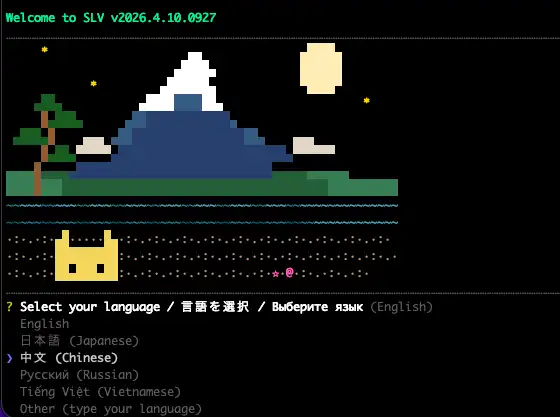
When the onboarding wizard launches, the language selection screen appears first. The five preset languages are listed in order of how many users speak them within the Validators DAO base.
- English
- Japanese
- Chinese
- Russian
- Vietnamese
In addition, selecting "Other" lets users enter any language name. Users whose mother tongue is not among the presets can simply type their language name and use SLV in that language.
The selection of preset languages reflects actual communication patterns observed in the Validators DAO official Discord. The number of users sending questions and feedback in their native language has grown visibly, and Chinese-language communication in particular has become especially prominent. The OS and terminal settings shown in shared screenshots have also increasingly been in languages other than English. The five preset languages were chosen based on these real-world usage patterns.
AI Console Also Operates in Your Mother Tongue — From Conversation to Execution, End to End
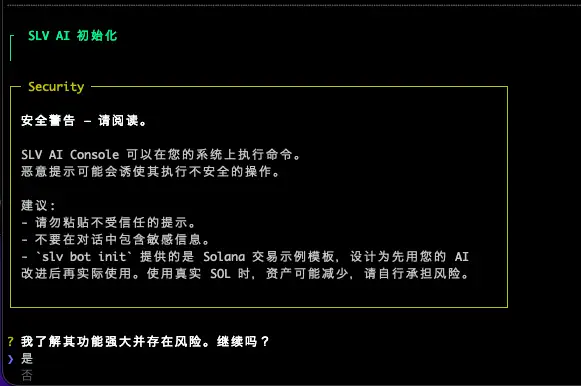
The language selected during onboarding carries over to the AI Console. Explanations from the AI agent, confirmation messages, security notices, operational result reports — all of these are displayed in the chosen language.
Users can make requests to the AI agent in natural language, read the responses returned in their mother tongue, and ask follow-up questions in their mother tongue. Validator upgrades, Solana Geyser gRPC configuration, Solana Shredstream setup, DoubleZero client startup, node migration — every task required for Solana operations can be carried out through native-language conversation.
Technical terminology is handled flexibly. Solana-specific jargon and terms that are more universally recognized in English are kept in English depending on context. When code needs to be displayed, the code is naturally shown as code. Users get explanations in their mother tongue while still seeing the necessary technical terms and code in their accurate form — this balance preserves both the readability of the native language and technical precision.
Language Settings Persist, and Can Be Changed Later
The language selected during onboarding is persisted as part of the SLV configuration. The next time the AI Console launches, it automatically starts in the same language. There is no need to choose the language each time.
Changing the setting is also straightforward. For users who want to switch between multiple languages, or for teams sharing an environment, the language setting can be changed at any time.
Local Mode and Remote Management — Both Supported
SLV's native multilingual support works in both local mode and remote management.
In local mode, where SLV runs directly on a node accessed via ssh, the AI Console launches in the selected language. Even when connecting to a node from a smartphone ssh client and conversing with the AI agent, operations can proceed entirely in the user's mother tongue.
In remote management configurations that orchestrate multiple nodes via Ansible, the SLV configuration on the management node retains the language setting, and AI agent conversations happen in the user's mother tongue.
Mobile Operations Combined with Multilingual Support
SLV supports running Solana validator operations from a single smartphone. As long as you have an ssh client on your phone, you can connect to a node, launch the AI Console, and start operating simply by talking to the AI agent.
What you can do from a smartphone is not limited to validator operations. Using the SLV AI agent, Solana trading app development can also be completed entirely from a phone. By simply asking the AI agent to build a trading app, users can assemble everything through native-language conversation: template generation, wallet creation, detection of new tokens on Pump.fun, automated buy and sell execution, and Discord notifications. Trading bot development, which previously required coding skills, infrastructure knowledge, and a significant time commitment, has entered a stage where it can be started with nothing more than a smartphone and natural language.
When multilingual support is layered on top of this mobile operation and mobile development, the freedom expands further. From anywhere in the world, in your own mother tongue, with a single smartphone — you can now build, operate, and troubleshoot Solana validators, and develop Solana trading apps. This is the stage Solana development and operations have entered.
YouTube (Start a Solana validator with the AI agent from your smartphone):
YouTube (Build a Solana trade bot with SLV AI from your phone — live Pump.fun sniping):
Contribution to the Solana Network as a Whole
Being able to converse with the AI agent in your mother tongue is not merely a convenience improvement. Reducing operational errors in validator management, lowering the barrier to new entrants, enabling validator participation from a wider range of regions — all of these contribute to the processing quality and fault tolerance of the Solana network as a whole.
Solana is a distributed compute network. The performance of the network as a whole is the sum of the performance of each individual validator distributed around the world. And each of those validators is operated by people across the globe. When an environment exists where operations can be conducted in one's mother tongue, more operators from more regions can participate in the Solana network, and the decentralization and resilience of the network as a whole grow stronger.
SLV's native multilingual support is a meaningful step forward from this perspective as well.
Performance Backing — Epics DAO Validator Ranks World #3
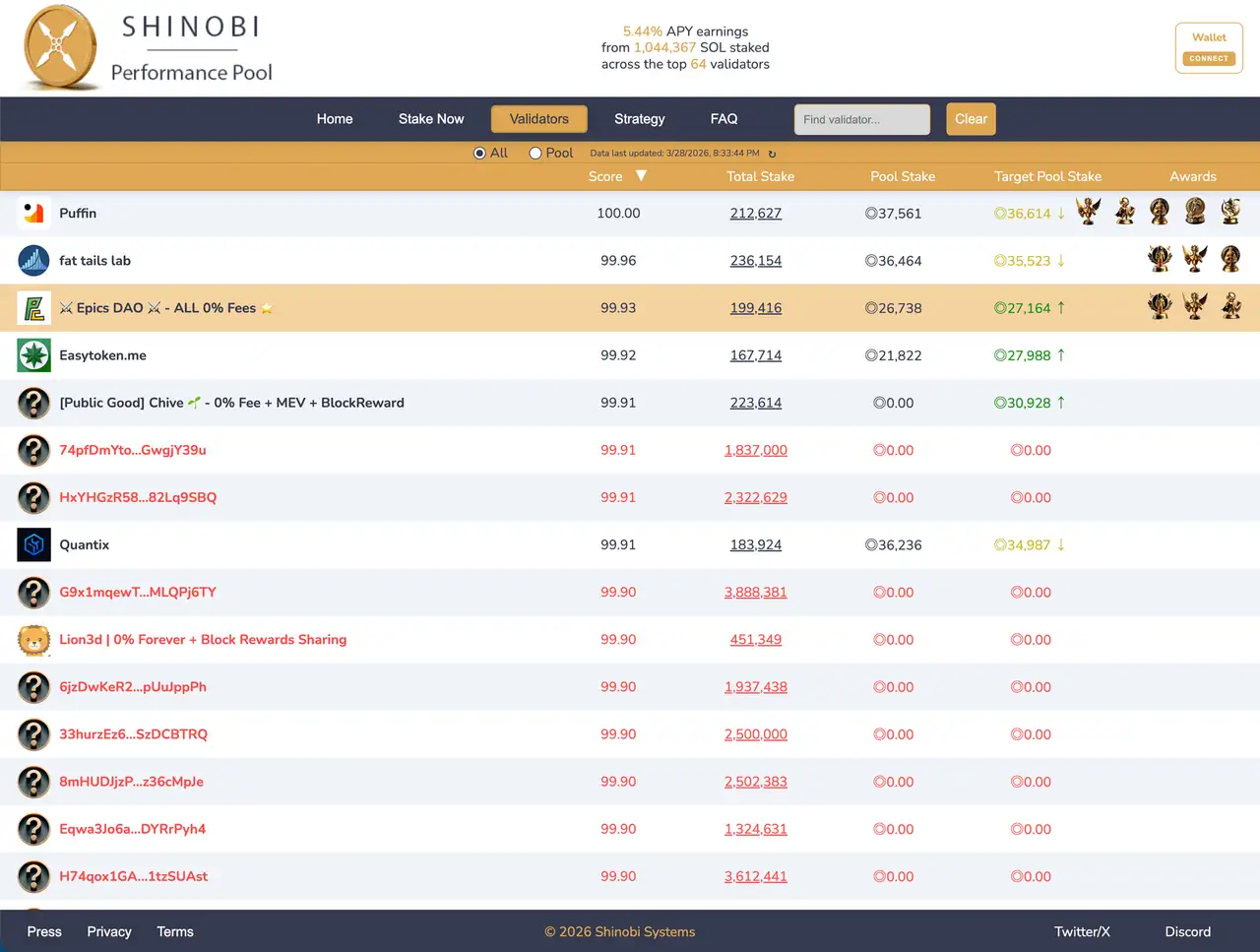
The Epics DAO validator, which serves as the source for ERPC's SWQoS endpoint and Epic Shreds, has reached world #3 (score 99.93) in the Shinobi Performance Pool among all Solana validators. The operational expertise behind this result is consolidated as SLV skills within the AI agent.
Conversing with the SLV AI agent in your mother tongue means applying world-class validator operational expertise directly to your own environment, in your own language.
SLV AI Tokens — 100,000 Tokens Free with €5 Authorization
ERPC's SLV AI Tokens make it possible to use SLV AI natively. As a launch promotion, completing a €5 authorization grants 100,000 tokens for free. This is a sufficient volume to experience the new native-language operational workflow.
Connections via ChatGPT and Claude API tokens are also supported, so users can run SLV AI with their own API keys. That said, the SLV AI provided by ERPC is configured with a model setup optimized for the context of Solana validator and RPC operations as well as Solana app development, making it easier to achieve higher task accuracy and efficiency at the same token volume.
ERPC SLV AI Plans: https://erpc.global/en/price/
Combined with the ERPC Platform
By deploying environments built with SLV onto the ERPC platform, users immediately gain access to high-speed in-platform snapshot downloads, zero-distance communication with Solana validators, and Solana-specific tuned configurations from the start. Solana RPC, Solana Geyser gRPC, Solana Shredstream (Epic Shreds), bare metal servers, high-performance VPS, and ERPC Global Storage are all integrated within the same platform.
The DoubleZero dedicated fiber network is also integrated across all regions, achieving roughly 200ms P99 latency reduction in the Asia regions (Tokyo and Singapore) in particular. Environments built by the SLV AI agent receive the benefits of these infrastructure optimizations with no additional configuration.
ERPC Official Site: https://erpc.global/en
Provided as Open Source
SLV itself continues to be provided as open source. The source code is available on GitHub and free to use, modify, and redistribute. This native multilingual support is also released as open source for users worldwide.
SLV GitHub: https://github.com/validatorsDAO/slv
Five Consecutive Years of WBSO Approval
ELSOUL LABO has received approval under the Dutch government's WBSO R&D support program for five consecutive years since 2022. The results of ongoing research and development on Solana RPC infrastructure, validator operations orchestration, and AI-agent-based Solana operating environments are implemented directly into the SLV toolchain and AI agents. The opening of our Solana-specialized data center under our own ASN (AS200261), assigned by RIPE NCC, is also planned for this month, providing an even faster foundation for the environments that the SLV AI agent builds.
We Welcome Your Feedback
SLV improves day by day thanks to feedback from our users. This native multilingual support also grew from many voices submitted to the Validators DAO official Discord. Requests for additional preset languages, suggestions for translation improvements, observations from using SLV in your mother tongue — all kinds of feedback are welcome.
Please give it a try and share your impressions and requests. Your feedback continues to evolve SLV into an even more usable tool.
Thank you, as always. We look forward to your continued support of SLV and ERPC.
Contact
For inquiries about SLV and ERPC, please open a support ticket on the Validators DAO official Discord.
Validators DAO Official Discord: https://discord.gg/C7ZQSrCkYR
News