
ELSOUL LABO Selected for WBSO 2026, Receiving Dutch Government Approval for the Fifth Consecutive Year as a Distributed Systems R&D Organization Including Solana
ELSOUL LABO Selected for WBSO 2026, Receiving Dutch Government Approval for the Fifth Consecutive Year as a Distributed Systems R&D Organization Including Solana
ELSOUL LABO B.V. (Headquarters: Amsterdam, Netherlands; CEO: Fumitake Kawasaki) has received official approval for its 2026 research and development projects under the Dutch government’s R&D incentive scheme, WBSO (Wet Bevordering Speur- en Ontwikkelingswerk), administered by the Netherlands Enterprise Agency (Rijksdienst voor Ondernemend Nederland, RVO). Since 2022, ELSOUL LABO has successfully passed the annual review process for five consecutive years.
This approval covers research and development projects submitted for the 2026 period, targeting distributed systems—an area in which underlying assumptions and operating conditions tend to change frequently—and reflects the result of an annual review conducted for that year’s application.
What Is WBSO
WBSO is a Dutch government program designed to support research and development activities. The focus of its evaluation lies in the substance of the R&D itself. In particular, the review examines whether the challenges addressed involve technical uncertainty, and whether the R&D activities include iterative experimentation aimed at resolving that uncertainty.
WBSO is not an automatically renewed program. Applications are submitted and reviewed on an annual basis, with research themes, research content, and implementation frameworks assessed for each applicable period. In fields such as distributed systems, where underlying assumptions continue to evolve, it is difficult to sustain R&D by fixing the scope indefinitely. Whether the research scope is continuously updated and integrated with real operational constraints is therefore an important factor in the evaluation.
Conditions for R&D Evaluated Under WBSO
R&D activities considered under WBSO are distinct from routine implementation work or development processes with established procedures. The focus is on initiatives that address challenges involving technical uncertainty, where outcomes cannot be determined using existing methods alone, and that progress through repeated validation and iteration.
Furthermore, such initiatives are expected to be connected to real-world implementation and operation rather than conducted in isolation from business activities. In the domain of distributed systems, multiple factors—such as low latency, stability, observability, reproducibility during failures, and adaptability to configuration changes—must be addressed simultaneously. Because the dominant factor varies depending on circumstances, these challenges cannot be reduced to a single performance metric. Defining and continuously addressing these combined conditions as a structured problem is itself a prerequisite for R&D to be considered valid.
R&D Projects Approved for 2026 at ELSOUL LABO
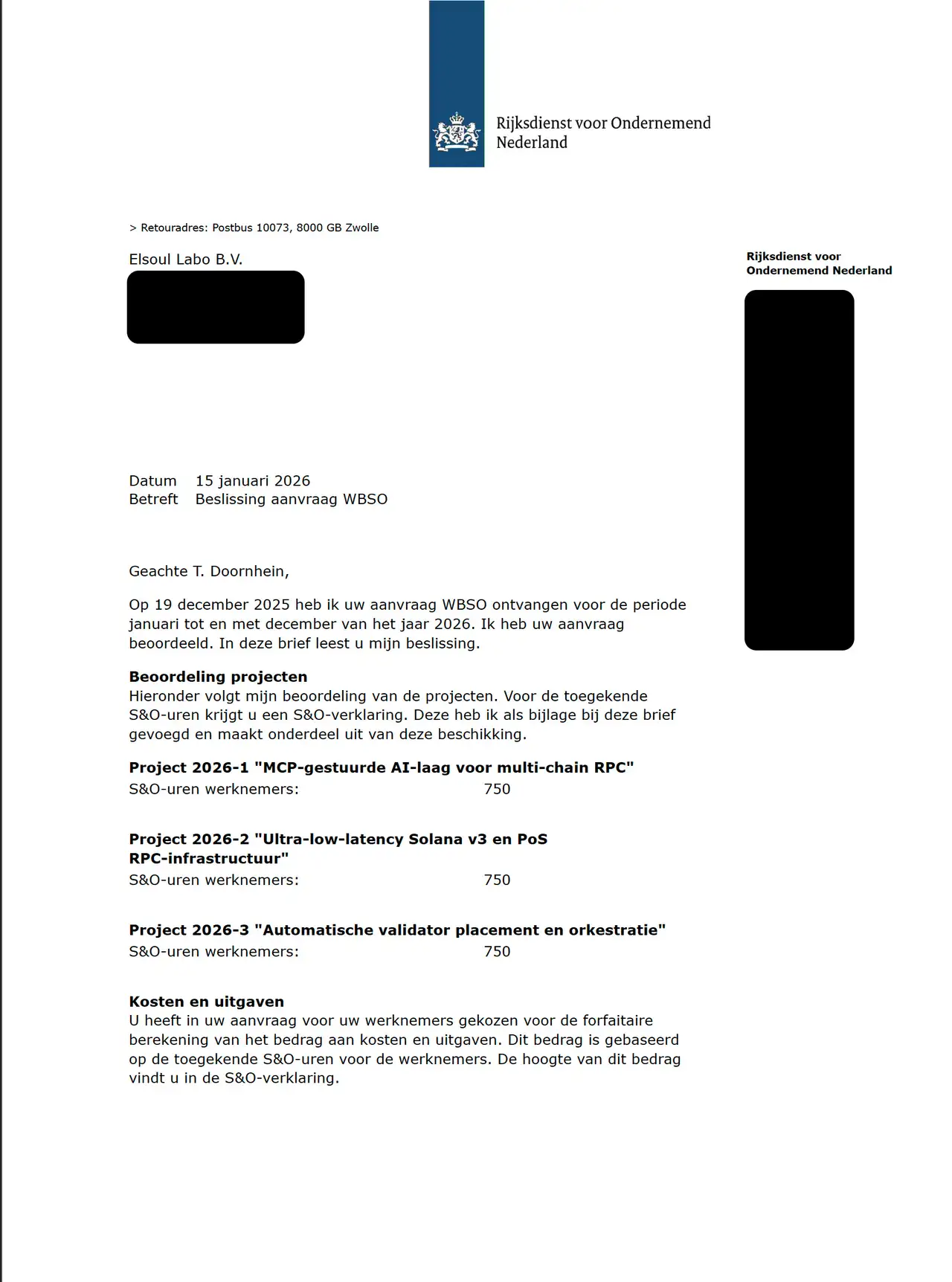
The following three research and development projects were approved for ELSOUL LABO for the 2026 period:
- Research and development of a multi-chain RPC architecture using an AI layer controlled via MCP
- Research and development of a low-latency Solana v3 / PoS RPC infrastructure
- Research and development of automated validator placement and operational orchestration
All of these projects share a common focus on challenges related to the design, operation, observability, and long-term continuity of distributed systems.
Core Research Focus of Each Project
In the multi-chain RPC research project, ELSOUL LABO is studying an architecture that combines an AI layer with an MCP-based control layer. Here, AI is not treated merely as an auxiliary tool for efficiency or convenience, but as a component for handling decision-making and control within distributed systems through reproducible procedures. As a result, improvements in developer support, user support, developer experience, and user experience are expected.
In Web3 development, application development and infrastructure design are often treated as separate domains, and server procurement, network conditions, observability design, and incident troubleshooting have tended to remain within the domain of specialized expertise. This project addresses such decision-making areas by making them subject to dialogue and verification, shifting complexity from individual dependence toward shared, collective knowledge. Improvements in developer experience are positioned as a means to support project continuity, development speed, and overall product quality, by enabling reproducible and continuously updatable environment design and operational decisions.
In the Solana v3 / PoS RPC infrastructure research project, the objective is to achieve low latency with both reproducibility and continuity. In real-world Solana operations, overall performance is influenced not only by the processing speed of the RPC itself, but also by the coherence of the entire data path, including data retrieval, distribution, observation, and execution. As network conditions and load fluctuate, bottlenecks shift depending on the situation. This project therefore focuses on iterative design and verification of configurations that remain viable under real operational constraints, including configurations based on Solana v3 / PoS.
In the research project on automated validator placement and operational orchestration, the focus is on addressing operator-dependent aspects inherent in distributed network operations. Validator operations involve a combination of geographic factors, network routes, hardware characteristics, operational procedures, and incident response. If such operations remain highly dependent on individual expertise, quality becomes concentrated among a limited group of experienced operators, raising barriers to participation. This project studies the design of reproducible procedures for placement and operational decisions, and their implementation as orchestration mechanisms that can be made broadly available. The objective is not merely to reduce operational effort, but to establish structures that allow the quality of distributed systems serving many users to be maintained on an ongoing basis.
Why ELSOUL LABO Continues R&D in This Domain
ELSOUL LABO is able to continue R&D in the field of distributed systems because research is not separated from implementation and operation. The company simultaneously conducts open-source software development, DAO operations, hands-on operation of distributed infrastructure, and the construction of a high-quality global Solana network (ERPC) within a single organization.
Research hypotheses are implemented, tested under real operational constraints, and the limitations and failures observed during operation are directly incorporated into subsequent research themes. When this cycle is sustained, research converges not on theoretical proposals alone, but on designs that function under real-world constraints. In the distributed systems domain, where assumptions cannot be fixed, research must continue to be validated through operation; otherwise, it will quickly be overtaken by reality. A structure in which research, implementation, and operation are not separated underpins the continuity of R&D.
Global-First R&D
ELSOUL LABO conducts its distributed systems R&D on the assumption of a globally distributed Solana infrastructure environment. Research activities proceed on the basis of infrastructure that is currently in operation.
The ERPC operating regions that form the basis of this research are as follows:
- Amsterdam
- Frankfurt
- London
- Dublin
- New York
- Chicago
- Salt Lake City
- Tokyo
- Singapore
Closing
ELSOUL LABO will continue to reflect insights gained through open-source development, DAO operations, and the real-world operation of globally distributed infrastructure into its R&D efforts, supporting the creation of environments in which many development teams working on Web3 can continue development and operations under realistic conditions.
For the latest updates, please visit the official Validators DAO Discord channel:
https://discord.gg/C7ZQSrCkYR
https://discord.gg/C7ZQSrCkYR
News