
ERPC Announces Complete Sell-Out of High-Performance High-Clock CPU Bare Metal Servers for Solana Applications in the Amsterdam Region
ERPC Announces Complete Sell-Out of High-Performance High-Clock CPU Bare Metal Servers for Solana Applications in the Amsterdam Region
ERPC, operated by ELSOUL LABO B.V. (Headquarters: Amsterdam, Netherlands; CEO: Fumitake Kawasaki) and Validators DAO, announces that all high-performance, high-clock CPU bare metal servers designed for Solana application workloads in the Amsterdam (AMS) region have been fully sold out.
This follows the recent sell-out announcement for the Frankfurt region, with similar demand concentration occurring within a short period of time. As a result, this configuration is no longer available for immediate provisioning and will now be offered exclusively via a waitlist.
Release Overview
The bare metal servers that have sold out were dedicated, high-performance high-clock CPU systems specifically designed for real-world Solana application operations.
This sell-out is not the result of a temporary campaign or short-term demand spike. It reflects sustained demand convergence toward the same conditions after extensive comparison, measurement, and continuous real-world operation, with performance prioritized above all else for Solana workloads.
In the Amsterdam region as well, sell-outs have occurred repeatedly in the past. The current sell-out represents a continuation of this pattern. Consequently, all immediately available inventory has been exhausted, and the configuration is now available only via waitlist.
Positioning of the Bare Metal Configuration
Real-world Solana application operations involve continuous, high-frequency workloads such as Shreds-related processing, transaction submission, detection, analysis, and backend execution. These workloads cannot be adequately evaluated using one-off benchmarks or peak theoretical performance alone.
What matters is whether processing can continue under identical conditions without increased latency or failure rates during peak load periods or when external disturbances occur. In Solana use cases, “performance” is not defined solely by numerical values, but by the ability to maintain stable conditions in production.
CPU generation and clock speed are important factors, but high specifications on paper do not automatically translate into expected results in production. In practice, data center operational policies, network architecture, behavior under congestion, and surrounding resource contention create significant differences in perceived performance.
ERPC selects only those configurations that have been validated through measurement and sustained real-world operation to remain resilient under Solana production conditions.
Structural Demand Concentration in Solana
As performance optimization in Solana is pursued rigorously, demand ultimately concentrates on data centers that satisfy a specific set of conditions. These conditions go beyond simply having high hardware specifications.
They include network quality that remains stable during congestion and external disturbances, operational policies that allow sustained CPU turbo behavior, and proximity to networks where major Solana nodes and validators are densely clustered. Whether all of these conditions are simultaneously satisfied directly determines real-world performance.
The more seriously comparisons and measurements are conducted, the fewer data centers globally continue to meet these criteria. This concentration of demand is not driven by specific vendors or short-term trends, but is an inevitable outcome derived from Solana’s network structure itself.
Why Amsterdam
Amsterdam is the second-largest city in the world, after Frankfurt, in terms of Solana validator and stake concentration. This fact carries significant implications for real-world Solana operations.
In Solana, block leaders rotate at short intervals, and the origin point of communication constantly shifts. What matters is not permanent proximity to a specific counterparty, but a high probability of repeatedly being close to the moving origin points over time.
Amsterdam has a long history as a financial and internet exchange hub in Europe. Centered around AMS-IX, the city hosts a dense, high-quality network ecosystem and functions as a major traffic aggregation point connecting Eastern, Western, Northern, and Southern Europe. These characteristics contribute to network paths that are less likely to degrade even during congestion or external disruptions.
Amsterdam has also developed as a hub for high-frequency trading and financial infrastructure. Blockchain applications are financial applications, and their real-world operation requires low latency, reproducibility, and resilience to external disturbances. Infrastructure built under these assumptions exhibits strong alignment with the operational requirements of Solana applications.
Shared Characteristics of Frankfurt and Amsterdam
Both Frankfurt and Amsterdam are located near regions with high densities of Solana validators and serve as major international traffic hubs.
This is not merely a matter of geography. It increases the statistical likelihood of connecting to nearby leaders over time, thereby reducing practical costs such as latency, retransmissions, and failure rates.
As performance optimization efforts deepen through repeated comparison and validation, the selection process consistently converges on environments that meet these conditions. The sell-out in Amsterdam clearly reflects the same structural convergence observed in Frankfurt.
ERPC’s Data Center Selection Policy
ERPC exclusively uses premium data centers worldwide. This is not a marketing decision, but a prerequisite for achieving reproducible performance in real-world Solana operations.
ERPC has conducted identical measurements and real-world operations across multiple data centers and cloud environments, including prior experience operating on platforms such as Google Cloud and AWS.
However, in Solana use cases, general-purpose cloud environments often fail to deliver expected performance relative to cost. The more comparisons are conducted, the fewer environments remain viable. As a result, ERPC concentrates its resources on a very limited number of data centers that meet premium operational conditions.
Why Inventory Shortages Persist
Rack space in premium data centers that satisfy these conditions is physically limited. In particular, resources located on the same network or along extremely close paths to regions with dense Solana validator concentration are structurally scarce.
Even when demand increases, identical conditions cannot be replicated immediately. Due to these physical constraints, inventory shortages tend to persist on a long-term basis.
Pricing, Waitlist, and Upcoming Price Changes
For the Amsterdam region, this configuration will now be available exclusively via a waitlist.
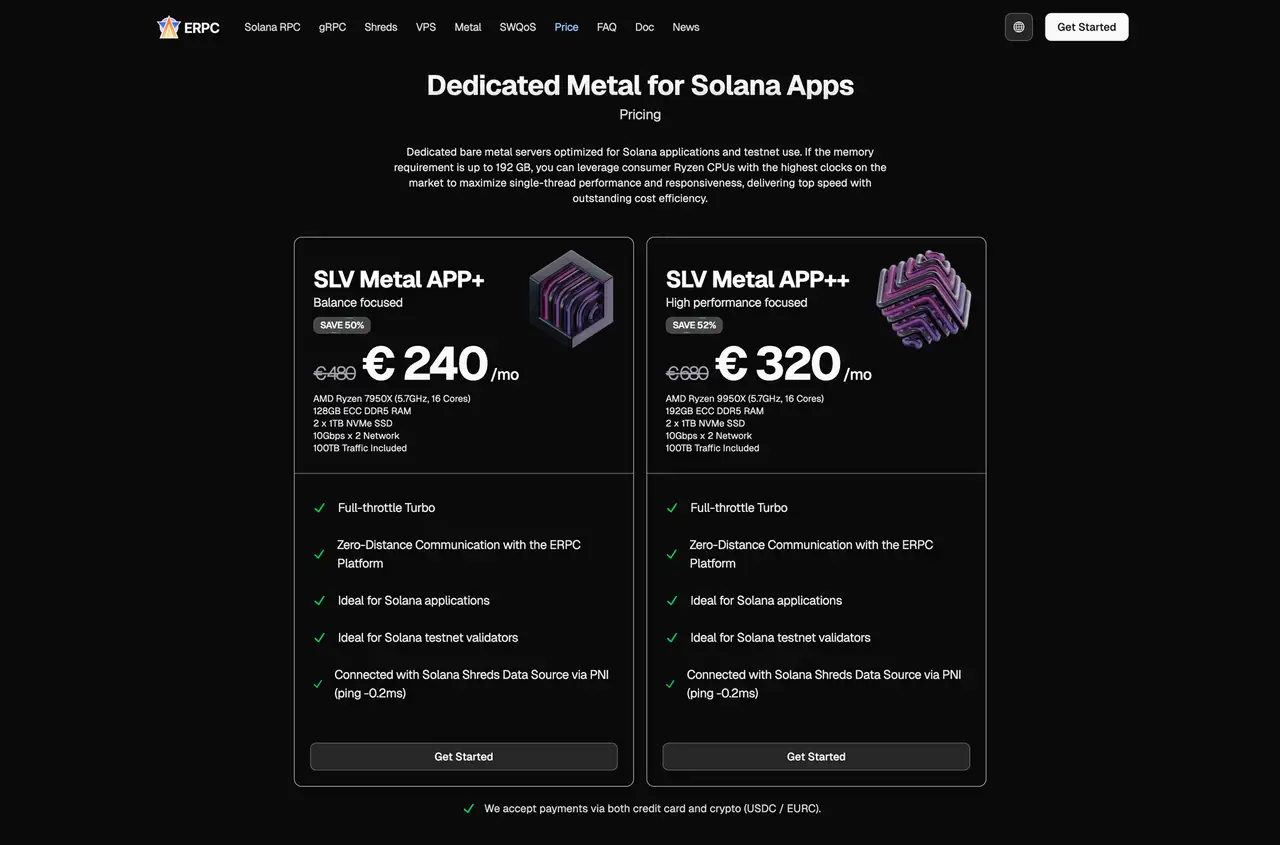
As already announced, new pricing will be applied to ERPC’s Solana products starting in February 2026.
For those considering deployment, registering for the waitlist within January 2026 ensures that the current open pricing will be applied.
Closing
The sell-out in the Amsterdam region is not driven by isolated regional factors. It demonstrates that the underlying conditions for Solana infrastructure selection have become explicit, and that demand is converging accordingly.
ERPC and Validators DAO will continue to prioritize real-world Solana performance and deliver premium-quality infrastructure globally.
For inquiries regarding waitlist registration or deployment consultations for high-performance bare metal servers in the Amsterdam region, please contact us via the Validators DAO Official Discord.
We sincerely thank all users for their continued support of ERPC.
- Validators DAO Official Discord: https://discord.gg/C7ZQSrCkYR
- ERPC Official Website: https://erpc.global/en
News