
ERPC Announces Full Sell-Out of High-Clock CPU Bare Metal Servers for Solana Applications in Frankfurt
ERPC Announces Full Sell-Out of High-Clock CPU Bare Metal Servers for Solana Applications in Frankfurt
ELSOUL LABO B.V. (Headquarters: Amsterdam, Netherlands; CEO: Fumitake Kawasaki) and Validators DAO announce that all high-performance, high-clock CPU bare metal servers for Solana application workloads in the Frankfurt (FRA) region, operated under ERPC, have sold out.
At present, new provisioning of this configuration is no longer available, and future allocations will be handled via a waitlist.
Release Overview
The bare metal servers that have sold out were designed specifically for real-world Solana application workloads, using dedicated high-clock CPU configurations optimized for sustained performance.
This sell-out was not driven by short-term campaigns or temporary spikes in demand. Instead, it is the result of continued demand converging on the same conditions after repeated comparison, measurement, and real-world operation, with performance as the primary criterion for decision-making in Solana environments.
As a result, all inventory prepared for this configuration in the Frankfurt region has been fully allocated, and immediate availability is no longer possible.
Positioning of the Bare Metal Configuration
In real-world Solana application operations, processes such as shred-related handling, transaction submission, detection, analysis, and backend processing occur continuously at high frequency and under tight timing constraints. These workloads cannot be accurately evaluated through isolated benchmarks or peak theoretical performance figures alone.
What matters is whether processing can continue under identical conditions even during peak load periods or in the presence of external disturbances, without increases in latency or failure rates. In Solana environments, “performance” is not defined solely by numerical throughput, but by whether operational conditions remain stable over time.
CPU generation and clock speed are critical factors. However, high values on a specification sheet do not, by themselves, guarantee expected results in real Solana operations. In practice, operational policies of the data center, network architecture, congestion behavior, and resource-sharing conditions all significantly affect experienced performance, even with identical hardware.
ERPC selects only configurations that have been verified through measurement and real-world operation to maintain stable conditions in actual Solana workloads.
The Structure of Demand Concentration in Solana
When performance is pursued rigorously in Solana environments, demand ultimately concentrates on data centers that satisfy a specific set of conditions. These conditions are not limited to having high hardware specifications.
They include network quality that remains stable under congestion or external disturbances, operational policies that allow sustained CPU turbo operation, and proximity to networks where major Solana nodes and validators are densely concentrated. Whether all of these conditions are met simultaneously determines real operational performance.
The more seriously comparison and measurement are conducted, the fewer data centers remain that satisfy these requirements on a global scale. This concentration of demand is not the result of temporary trends or individual providers, but a structural outcome derived from Solana’s network architecture itself.
Why Frankfurt
Frankfurt is the region where the largest number of Solana validators are concentrated globally. This fact has direct significance for real-world Solana operations.
In Solana, the leader responsible for block production changes at very short intervals, and the communication origin continuously shifts. In this environment, what matters is not proximity to a single fixed counterpart, but the probability of remaining close to the moving communication origin over time.
Placing infrastructure in a region with a high density of validators increases the statistical likelihood of proximity to active leaders, reducing latency, retransmissions, and failure rates in practical operation.
In addition, Frankfurt functions as a major international network hub, with a concentration of global transit routes. Even during congestion or external network disturbances, routes tend to remain stable. As a result, among data centers that meet the required conditions, the Frankfurt region consistently remains a strong candidate.
ERPC’s Data Center Selection Policy
ERPC operates exclusively on premium data centers on a global basis. This is not a marketing stance, but a prerequisite for achieving reproducible performance in real Solana operations.
ERPC has conducted measurement and real-world operation across multiple data centers and environments under identical conditions. Through this process, it has become clear that only a very limited number of facilities meet the conditions required for sustained Solana performance.
Accordingly, ERPC concentrates its resources exclusively on data centers that satisfy these premium conditions.
Why Persistent Shortages Occur
Rack space in premium data centers that meet these conditions is physically limited. In regions with dense Solana validator concentration, resources located on the same network—or in extremely close proximity—are structurally scarce.
This constraint cannot be resolved in the short term. Even as demand increases, identical-condition resources cannot be added immediately, leading to persistent shortages.
This phenomenon mirrors historical patterns observed in financial internet infrastructure, where rack space near critical servers gained premium value as network distance decreased by mere centimeters. The same process is now unfolding within the Solana ecosystem.
What This Sell-Out Indicates
This sell-out was not driven by pricing factors or temporary demand fluctuations. It reflects demand converging on specific conditions as a result of performance-based decision-making in Solana environments.
While ERPC continues to secure resources wherever possible, physical constraints prevent full accommodation of demand. This situation is likely to persist.
Waitlist Information
The Frankfurt-region configuration is now available exclusively via a waitlist.
An overview of current configurations and pricing is available in the following pricing table.
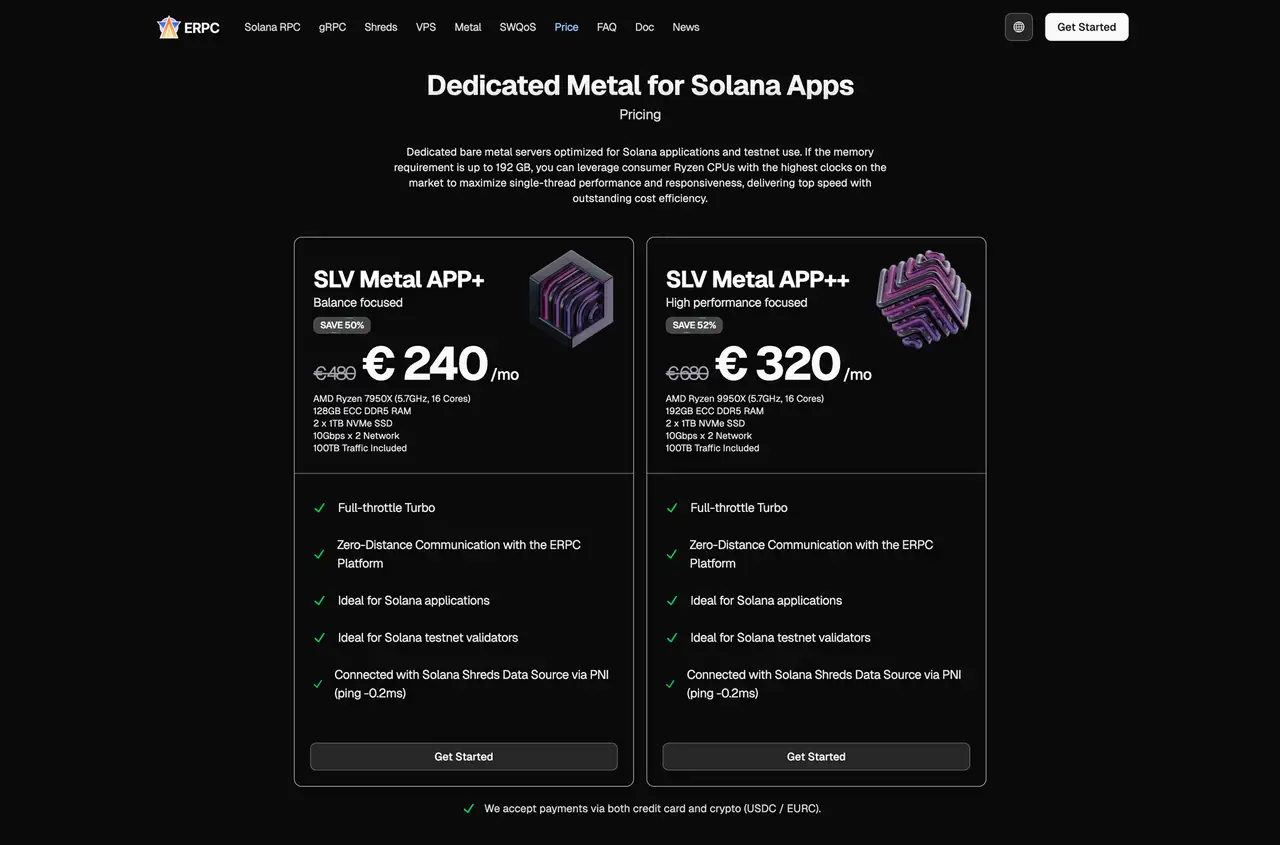
Waitlist registration and deployment consultations are handled via the official Validators DAO Discord. Allocations will be offered in order as capacity becomes available.
Validators DAO Official Discord: https://discord.gg/C7ZQSrCkYR
Global Hardware Supply Conditions
Driven by the expansion of AI and blockchain industries, global demand for computing resources continues to rise. CPUs, memory, storage, and networking equipment are all experiencing simultaneous supply constraints and price increases.
ECC memory and latest-generation CPUs are particularly affected, and these conditions are not expected to normalize in the short term. Infrastructure planning and operation must proceed under these assumptions.
Closing
ERPC and Validators DAO will continue to prioritize real-world Solana performance and provide premium-quality infrastructure globally.
The conditions described in this release are not temporary. They reflect a structural shift in the baseline assumptions for infrastructure selection within the Solana ecosystem.
For waitlist registration or deployment consultations regarding high-performance bare metal servers in the Frankfurt region, please contact us via the Validators DAO official Discord.
Validators DAO Official Discord: https://discord.gg/C7ZQSrCkYR
ERPC Official Website: https://erpc.global/en
ERPC Official Website: https://erpc.global/en
We sincerely thank all users for their continued support of ERPC.
News